
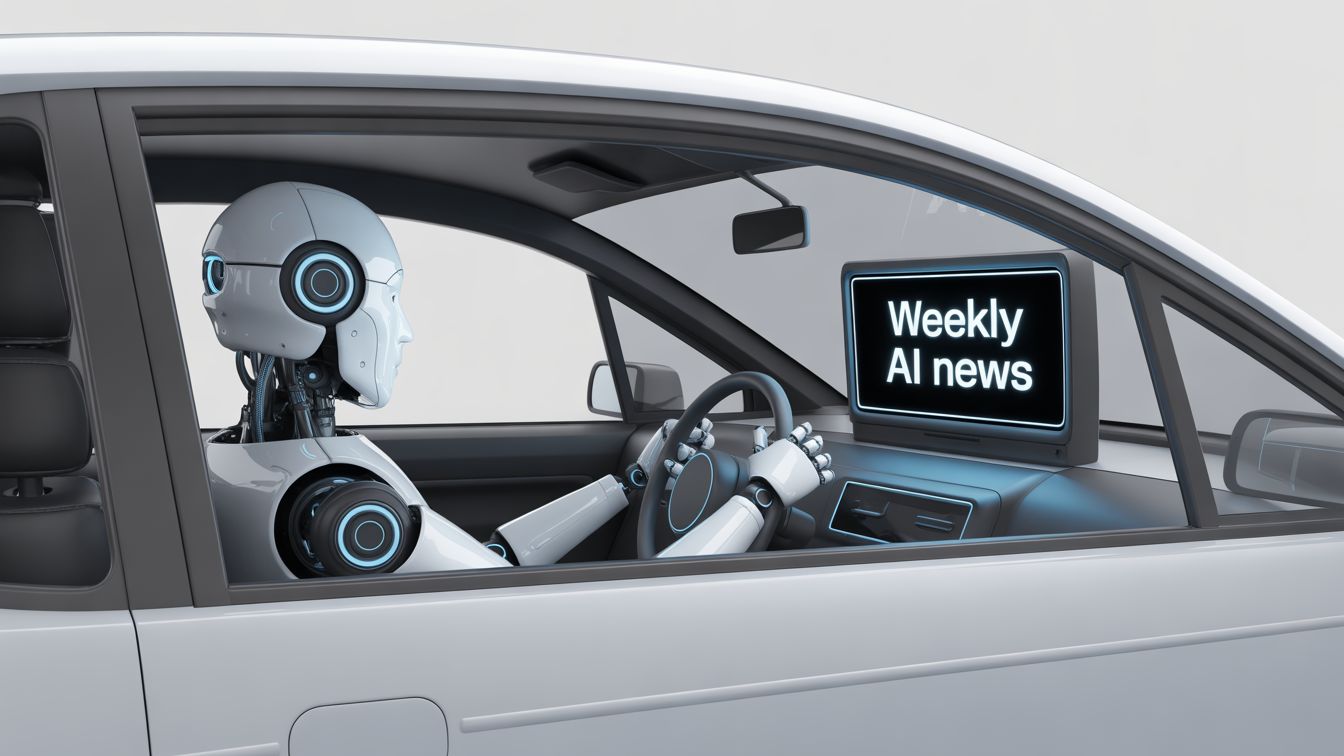
Last Week’s AI News #25
Mar 16, 2026AI headlines aren’t just piling up, they’re colliding. In the past week alone we saw government lawsuits against AI companies, new workplace agents that can run tasks across entire software suites, and tools that bring always-on AI assistants directly to your computer.
At the same time, AI is showing up in unexpected places: powering navigation apps, shaping social networks for bots, and even helping design experimental medical treatments.
For SMBs, the opportunity is simple but powerful: the companies that experiment early with these tools will move faster, automate more work, and uncover advantages their competitors miss.
Here’s what you need to know from last week in AI:
- Weekly AI Tip: Create an Internal AI Wins Channel
- Anthropic sues U.S. government over AI blacklist
- Microsoft introduces Copilot Cowork for AI-powered workflows
- a16z report shows AI app ecosystem expanding
- Meta hires creators of viral AI agent platform
- Perplexity introduces local AI agent system
- Elon Musk unveils ambitious AI agent project
- Google adds Gemini AI features to Maps
- AI helps create custom cancer vaccine for a dog
- Everything else that happened in AI last week
WEEKLY AI TIP:CREATE AN INTERNAL AI WINS CHANNEL
Slack / Teams / Workplace.
Rule:
Every AI use case must include:
- What task
- Time saved
- Tool used
- Before vs after
You build collective intelligence instead of isolated experiments.
Low effort. Massive cultural impact.
ANTHROPIC SUES U.S. GOVERNMENT OVER AI BLACKLIST
Anthropic filed two lawsuits challenging the U.S. government after the Pentagon labeled the company a “supply chain risk” and the White House directed federal agencies to drop the Claude AI system.
The company argues the label was meant for foreign adversaries, not domestic tech companies, and claims the decision was retaliation for publicly advocating limits on AI used in weapons and surveillance. More than 30 staff members from major AI labs signed a legal brief supporting Anthropic’s case, warning that the blacklisting could damage U.S. leadership in artificial intelligence.
Why does it matter for businesses?
The case could set an important precedent for how governments regulate AI companies. Businesses relying on AI platforms may see new legal and regulatory battles that affect which tools can be used in public or private sectors.
MICROSOFT INTRODUCES COPILOT COWORK FOR AI-POWERED WORKFLOWS
Microsoft unveiled Copilot Cowork, a new Microsoft 365 feature designed to automate complex work tasks across emails, meetings, files, and chat conversations.
The system runs in the background in the cloud, using enterprise context from the entire Microsoft 365 ecosystem. Users simply describe an outcome, such as creating a briefing deck or project report, and the system breaks the request into steps and generates deliverables across apps like PowerPoint, Excel, and Word.
The feature is currently in a research preview and will be bundled in a new $99-per-user enterprise tier that includes AI agent management and security tools.
Why does it matter for businesses?
Integrated AI agents inside productivity software could dramatically reduce manual work. For SMB teams already using Microsoft 365, tools like Copilot Cowork could automate reporting, presentations, and internal documentation.
A16Z REPORT SHOWS AI APP ECOSYSTEM EXPANDING
Venture firm Andreessen Horowitz released the sixth edition of its Consumer AI Top 100 report, offering a snapshot of how AI adoption is evolving globally.
ChatGPT remains the clear leader with more than 900 million weekly users, but competitors like Claude and Gemini are rapidly gaining ground, with paid subscriptions growing over 200% in the past year. For the first time, the report also included traditional apps enhanced with AI features, such as Canva, CapCut, Notion, and Grammarly.
The report also highlights the emergence of three separate AI ecosystems forming around Western, Chinese, and Russian platforms as geopolitical tensions reshape the market.
Why does it matter for businesses?
AI is no longer limited to dedicated tools. It’s increasingly embedded inside everyday software platforms businesses already use, from design to productivity apps, making adoption faster and more widespread.
META HIRES CREATORS OF VIRAL AI AGENT PLATFORM
Meta hired the creators behind Moltbook, a viral online forum designed specifically for AI agents to interact and coordinate with each other.
The platform quickly attracted attention for hosting millions of bots and a directory of verified AI agents that can communicate openly. It gained viral traction earlier this year alongside the rise of experimental AI agent communities.
The Moltbook team will now join Meta’s Superintelligence Labs as the company explores new ways to integrate AI agents into its ecosystem.
Why does it matter for businesses?
The rise of AI agent ecosystems suggests a future where bots collaborate, share data, and perform tasks across platforms. Businesses may soon rely on networks of AI agents working together rather than single tools.
PERPLEXITY INTRODUCES LOCAL AI AGENT SYSTEM
Perplexity launched Personal Computer, a local version of its AI agent system designed to run on a dedicated Mac mini.
The setup allows the company’s Comet assistant to access files, applications, and sessions on the computer while maintaining stronger security and control compared to fully cloud-based systems. The platform includes safeguards such as activity tracking, approval for sensitive tasks, and a kill switch to shut down the agent.
Enterprise customers can also connect the system to more than 400 applications and multiple AI models.
Why does it matter for businesses?
Local AI agents offer greater privacy and security while still automating complex tasks. SMBs may increasingly adopt always-on AI assistants that manage workflows directly on their computers.
ELON MUSK UNVEILS AMBITIOUS AI AGENT PROJECT
Elon Musk revealed new details about Macrohard, an AI software initiative from xAI that is merging with Tesla’s “Digital Optimus” agent system.
The project aims to combine Grok AI with real-time screen analysis and Tesla’s AI hardware infrastructure to build what Musk describes as a system capable of “emulating the function of entire companies.”
The announcement comes amid reports of internal team changes and employee departures within the project.
Why does it matter for businesses?
If AI agents can coordinate complex workflows across software and data in real time, they could automate large portions of business operations, from research and analysis to customer support.
GOOGLE ADDS GEMINI AI FEATURES TO MAPS
Google released a major upgrade to Google Maps powered by its Gemini AI model.
The update introduces Ask Maps, a conversational feature that lets users ask questions about routes, destinations, and stops. The system analyzes information from more than 300 million locations and reviews to generate helpful travel insights.
Another feature, Immersive Navigation, uses Street View and aerial imagery to render routes in 3D, helping users visualize buildings, intersections, and navigation details before they travel.
Why does it matter for businesses?
Google continues embedding AI into everyday products used by billions of people. Businesses that rely on local visibility, such as restaurants, retail, and tourism services, may benefit from smarter discovery tools in search and maps.
AI HELPS CREATE CUSTOM CANCER VACCINE FOR A DOG
An AI consultant in Australia used several AI tools to design a custom mRNA cancer vaccine for his dog after traditional treatments failed.
The process involved analyzing 350 GB of tumor data using tools including ChatGPT, Grok, and DeepMind’s AlphaFold to model the dog’s genetic mutations. Researchers then helped turn the findings into a vaccine formula.
After receiving the treatment, one tumor reportedly shrank significantly, with further treatments being developed.
Why does it matter for businesses?
This story highlights how AI is accelerating scientific discovery and enabling complex research workflows. Over time, these capabilities could transform healthcare, biotech startups, and pharmaceutical development.
EVERYTHING ELSE THAT HAPPENED IN AI LAST WEEK
- Anthropic – AI Code Review Agents: Anthropic launched Code Review for Claude Code in Team and Enterprise plans. The feature uses multiple AI agents to analyze code, identify bugs, and provide deeper technical feedback. SMB development teams can speed up software testing and reduce costly errors.
- OpenAI – Promptfoo Acquisition: OpenAI acquired Promptfoo, an AI security and red-teaming platform used to test AI agents for vulnerabilities. The integration will become part of OpenAI’s enterprise “Frontier” platform. SMBs deploying AI internally may benefit from better built-in safety and reliability testing tools.
- Andrew Ng – Context Hub Tool: AI pioneer Andrew Ng released Context Hub, a free tool that gives AI coding agents access to up-to-date documentation. This helps prevent agents from generating outdated or hallucinated code. SMB developers using AI coding tools may see more reliable outputs.
- Anthropic – Claude Marketplace: Anthropic launched Claude Marketplace in limited preview, allowing enterprises to use existing AI spending commitments on partner tools like GitLab and Harvey. SMBs could soon access a growing ecosystem of AI integrations inside Claude.
- Google – Gemini Embedding 2: Google introduced Gemini Embedding 2, a model that can search and understand text, images, video, and audio in one system. SMBs building search tools or knowledge bases could use multimodal AI to organize information across different content types.
- Nvidia – NemoClaw Enterprise Platform: Nvidia is preparing to launch NemoClaw, an open platform for running AI agents across different hardware environments. If widely adopted, SMBs may gain more flexibility when deploying AI agents without being locked into a single infrastructure provider.
- Replit – $400M Funding and Agent 4: Coding platform Replit raised $400M at a $9B valuation and launched Agent 4, an AI coding system designed to build applications faster using multiple parallel agents. SMB startups and small development teams may be able to create software products significantly faster.
- Amazon – AI Safety Reset After Outages: Amazon imposed a 90-day safety reset after AI-generated code changes caused outages that led to 6.3 million lost orders in one day. The company is now requiring additional verification for critical deployments. SMBs using AI for development may need stronger review processes to avoid similar risks.
- Cloudflare – Website Crawl API: Cloudflare introduced a new /crawl API endpoint that can scrape entire websites in a single request. The tool could help SMBs collect market research data, monitor competitors, or build AI-powered search and analysis systems.
- Bumble – AI Dating Assistant “Bee”: Dating app Bumble plans to launch “Bee,” an AI assistant that learns user preferences and suggests matches automatically. The trend signals how AI assistants are becoming personal agents that manage everyday decisions — a pattern SMB apps may adopt in their own customer experiences.
That’s it for this week’s AI briefing. From legal battles over who controls AI, to workplace agents that can generate reports and presentations automatically, the technology is steadily moving from experimentation into everyday operations.
For SMBs, the real advantage isn’t just knowing what happened, it’s recognizing which trends are about to reshape how work gets done.
We’ll keep tracking the biggest AI developments, the tools worth testing, and the shifts that could impact your business.
Stay ahead of the curve: subscribe to our newsletter and get the most important AI stories and practical insights delivered straight to your inbox every week.